Why teams struggle
Many call issues are transport-side, not prompt-side. Slow first response, jitter swings, and interruption lag are often introduced between carrier RTP and agent runtime media handling.

Resource — Optimization
Telepath is the carrier-to-agent connectivity layer. It terminates SIP/RTP from your carrier, adapts media for real-time AI runtimes, and bridges audio over WebSocket with ~12ms gateway processing so turn timing stays tight as traffic scales.
Many call issues are transport-side, not prompt-side. Slow first response, jitter swings, and interruption lag are often introduced between carrier RTP and agent runtime media handling.
Telepath owns the boundary: SIP signaling termination, RTP media termination, adaptive packet handling, and efficient transcoding to agent-compatible PCM streams.
You keep your carrier and AI stack, but gain a cleaner media path plus evidence that separates carrier behavior from gateway behavior and AI runtime behavior.
When an AI voice call underperforms, the first instinct is usually to look at the language model: reduce the system prompt, switch to a faster model, tune the temperature. These are often not the problem. A significant share of perceived latency and quality issues in AI voice deployments originate in the transport layer — the segment of the call between the carrier’s media server and the AI runtime’s WebSocket endpoint.
The core mismatch is architectural. SIP carriers deliver audio as G.711 PCMU or PCMA over RTP — a connectionless, packet-based protocol optimized for PSTN telephony. AI voice runtimes expect continuous PCM16 audio over a persistent WebSocket connection. Getting from one to the other requires protocol translation, codec transcoding, jitter buffering, and careful timing management. If any of these steps is implemented carelessly, the result is added latency, audio discontinuities, or both.
Transport optimization in AI voice isn’t a single change — it’s a sequence of measurements followed by targeted adjustments. The process typically follows this order:
1. Establish a measurement baseline. Before changing anything, instrument per-call TTFS, packet loss, jitter, and SIP setup timing. Without this baseline, you cannot distinguish a successful optimization from noise.
2. Identify the primary bottleneck. Is your P95 TTFS driven by carrier SIP setup time, gateway processing overhead, or model inference latency? These are different problems with different solutions. Mixing them up causes teams to optimize the wrong layer for weeks.
3. Reduce transport overhead first. Gateway processing should add no more than 10–15ms to the call path. If your media bridge is adding 80ms due to buffering, transcoding chains, or geographic relay distance, that’s recoverable overhead that doesn’t require touching your model or prompts.
4. Address carrier routing. Some carriers have regional media server routing that is suboptimal for specific origin/destination combinations. Per-carrier SIP timing analysis can reveal whether carrier-side setup latency is a persistent contributor and whether an alternative carrier configuration or trunk group routing improves it.
5. Tune for tail latency, not averages. Average TTFS improvements don’t address the calls that feel sluggish. Track P95 and P99 TTFS and focus optimization effort on reducing the tail, since that’s what callers actually complain about.
Telepath is carrier-agnostic. Any provider that delivers standard SIP/RTP is compatible: Twilio, Telnyx, Bandwidth, Vonage, Plivo, SignalWire, Flowroute, Sinch, and custom SIP infrastructure. The transport optimization work happens at the Telepath boundary regardless of which carrier originates the call. Per-carrier quality analytics let you compare performance across providers on a consistent measurement basis.
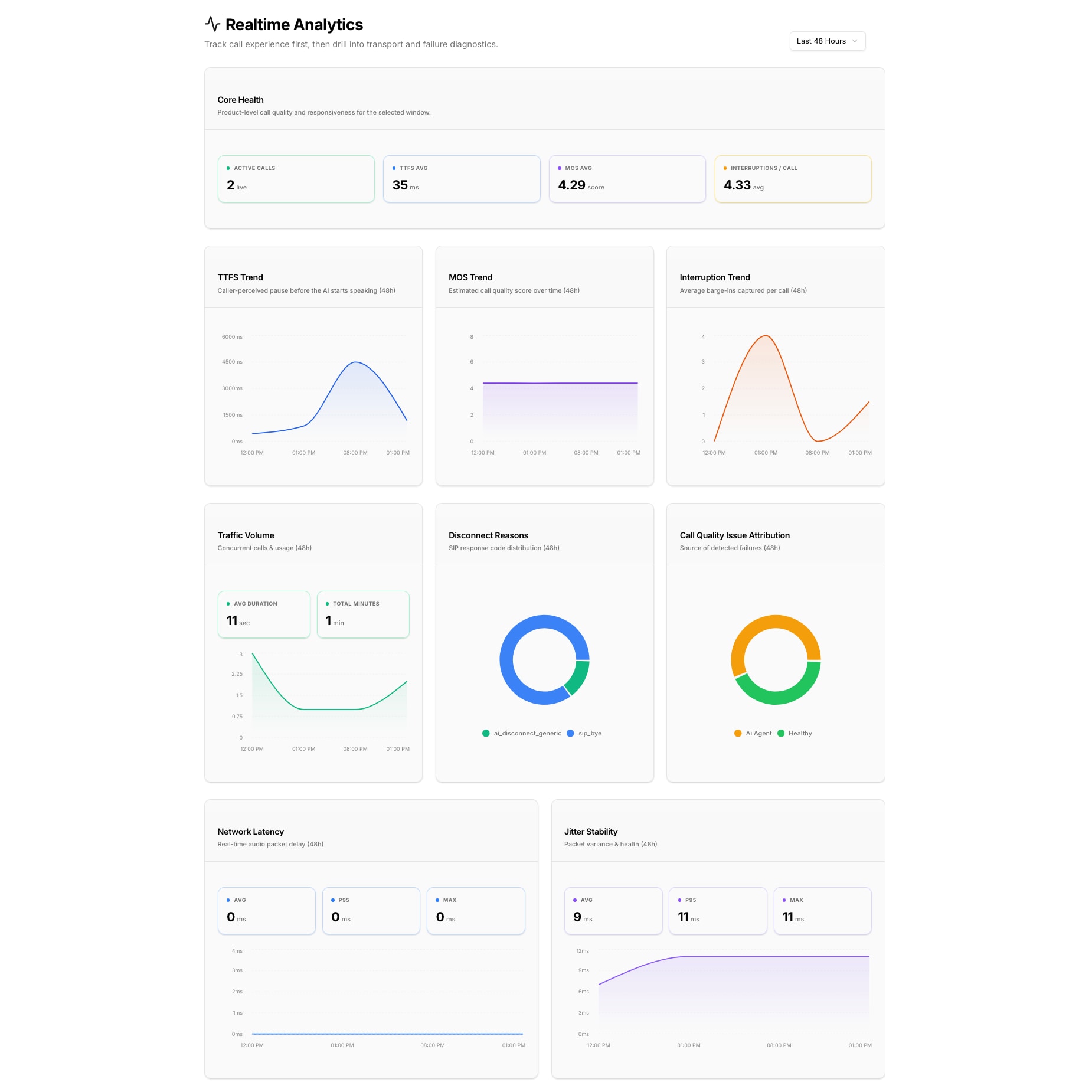
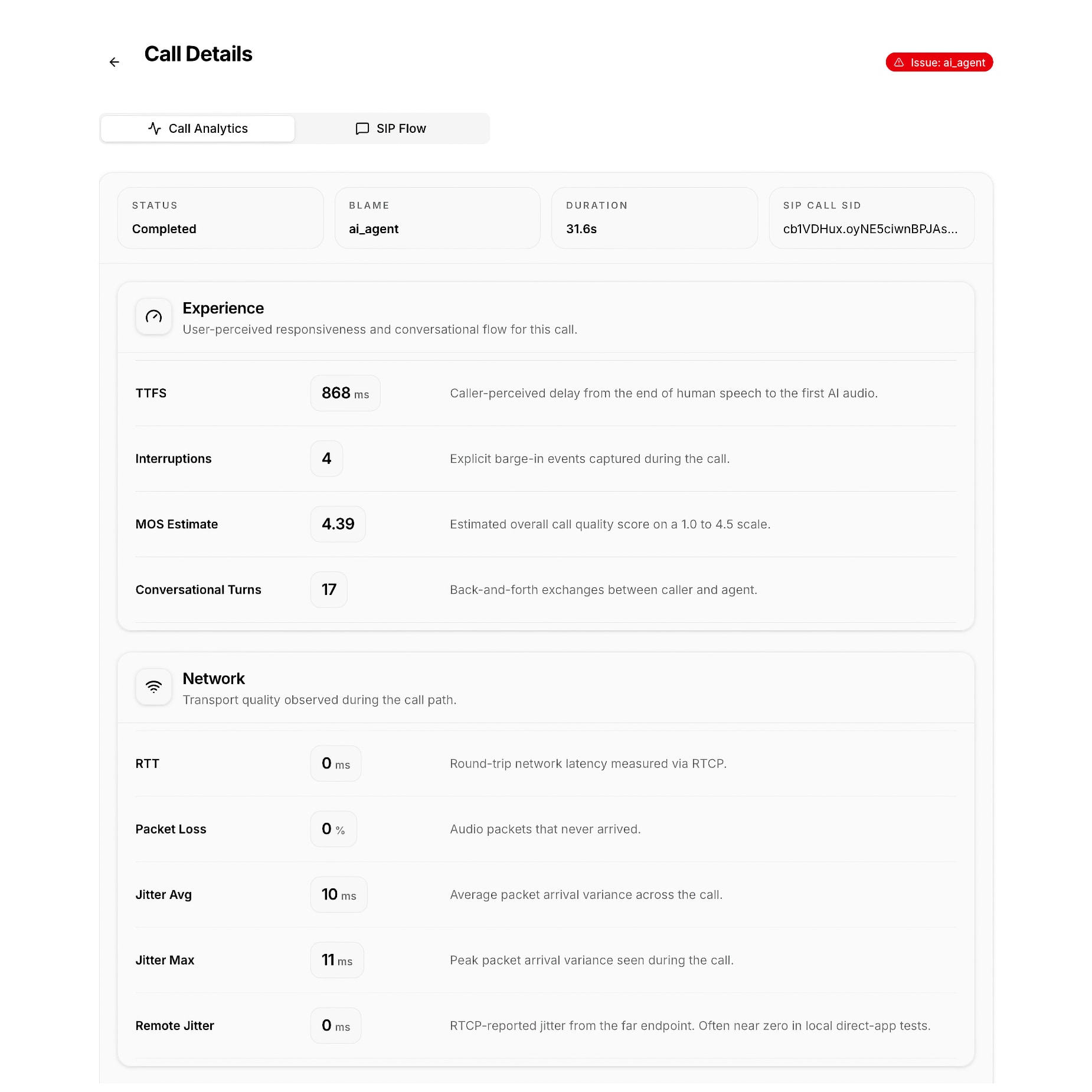
Click any image to inspect full-size detail. These visuals are the artifacts teams use for triage, incident review, and carrier escalation.
Track TTFS, interruption capture, and conversational timing so optimization maps to caller experience, not just backend metrics.
Use packet and signaling evidence to prove whether degradations came from the network path, the gateway boundary, or the AI runtime.
Telepath focuses on transport and observability only. Number provisioning and model hosting stay with your existing providers.
Use Telepath to standardize carrier-to-agent media flow, reduce avoidable latency overhead, and instrument every call path with actionable diagnostics.